
Advocating for Canopies: What Does It Mean to Speak for the Trees?
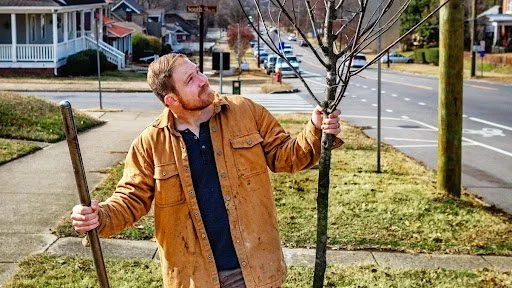
In Dr. Seuss' cautionary tale, The Lorax, the furry orange creature "...speaks for the trees, for the trees have no tongues." As environmental advocates, we at the Nashville Tree Conservation Corps relate to the calling to lend our voices to protect our canopy!
In this article, we'll explore how language is an essential tool for canopy care and why talking about trees and using good information is foundational to developing long-term solutions to counter deforestation, such as legislation and canopy management programs. Towards the end, we'll consider how each and every person can play a role in supporting our local tree canopy by engaging in the dialogue.
What Does It Mean to Speak for the Trees?
Language is a wide-ranging tool, which, like shovels and money, can be used to help plant and maintain trees, and to take action to preserve and protect them. Urban canopy managers use language to collect and interpret data, share best practices, discuss their activities, and make rules about removing and planting trees. How information is presented and communicated can be as important as the content itself: it needs to be in understandable, relatable language to be effective and usable.
Interpretation is the term we use to describe education about environments and ecological systems, but it’s more than just teaching: environmental interpretation makes information relevant, connecting facts about big concepts to things that matter to us in our lives, like the shade from trees and the wildlife that inhabit them, in addition to many other ecosystem services that affect us daily.
How Do People Speak for Trees?
There are many ways we can speak for the trees! Most environmental management activities require clear communication in:
Education: Teaching and learning about trees, canopy ecosystems, and the built environment helps us understand how these work and how we can manage conditions and assess needs.
Research and best practices: Information about needs, conditions, and proven tactics for tree care and environmental management in general creates standards we can use, reference, and evaluate with.
Advocacy: Knowledge helps us discuss the importance of trees and good tree care with friends, family, neighbors, lawmakers, and in business, helping us encourage action-taking and decision-making in the interest of healthy trees and canopies.
Legislation: Law is based on language: it is argued and written, and legislators use research and community feedback to make enforceable rules that govern many tree management practices within the city.
Planning: Plans communicate the intent of projects and programs, and serve as strategic reference documents and guidelines. Coordinating and informing stakeholders and collaborators requires regular, active communication supported by good written content.
Monitoring, data collection, and communication: Assessment reports, milestone updates, news, and data monitoring all contribute new information to us in an ongoing way that needs to be filtered and made relevant to inform decision-makers in the most effective way.
Being pragmatic with our language means using information to manage and improve what we do, and when it comes to natural resources, decision-makers need good, timely information in constantly changing environments.
Environmental management is a lot of risk management, which is all about getting the right information to the right people at the right time. To be effective, information needs to be clear and usable: there is a lot of it in the world today, more than ever, and it needs to be regularly sorted through and transformed into usable knowledge.
How Can You Speak for Trees?
Decision-makers regarding environmental conditions don’t only include government and nonprofits, but also businesses and residents. Property owners in Nashville manage a very large portion of the city’s canopy, making consequential decisions about whether trees are present and in what condition they’re maintained. While the city manages trees on public property, homeowners and businesses are major players in local environmental management, and citizens in general contribute to the conversation in various ways. NTCC’s team loves answering questions about preserving your own home’s canopy.
Anyone can participate in local canopy management, which is an area-wide activity that requires lots of collaborators!
Learn about trees, canopy care, and ecology with books, documentaries, online content, and even with nature groups; explore your favorite topics in depth.
Talk to friends and family about the important benefits of trees, as well as their experiences with trees, to encourage awareness of those connections.
Advocate for tree-friendly legislation that counters deforestation due to short-term political and financial ends by writing to government officials.
Volunteer with and donate to environmental nonprofits.
Consider a career in an environmental field.
Everyone has a role to play! Thinking about your talents, skills, and interests can help reveal what connections you can engage with for the benefit of trees near you.
Care for the Canopy in Nashville
The Lorax ends with a single word warning: “Unless.” Things won’t change “...unless someone like you cares quite a lot.” There is much yet to do, and the work is ongoing, since urban forest management is a constant activity. Right now, we can look at the great work that is being done that gives us hope for the future, and also say that it’s “because” people like you care quite a lot.
We’re sure people care because we work with those caring people all the time! We couldn’t fulfill our mission without the network of volunteers and experts across Nashville that contribute to our success. Your financial donations to NTCC, tree purchases through our annual sale, and active participation in community events demonstrate that Nashvillians back up their tree talk with on-the-ground action!
Subscribe to our newsletter for regular updates on Nashville’s canopy, and check out our Linktree for more ways to connect.